



























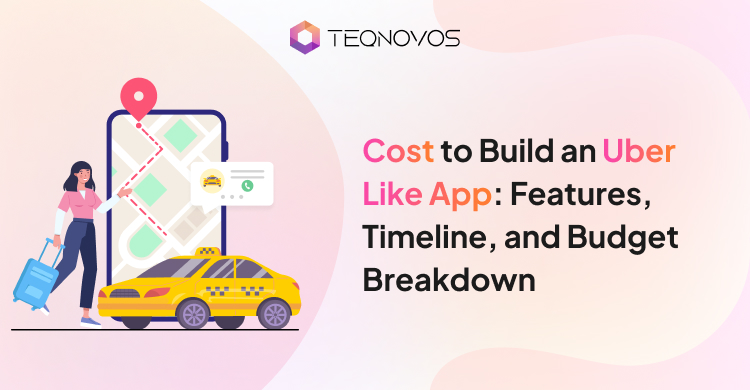
Cost to Build an Uber Like App: Features, Timeline, and Budget Breakdown
Building an Uber like app requires planning beyond the mobile interface and selecting the right mobile app development services for the required platform scope. The cost to build Uber like app varies based on the type of platform being developed, customization requirements, and launch objectives. A focused MVP requires a smaller investment, while a broader mobility platform needs additional systems for multiple services and operational management.
The final Uber like app development cost changes based on technical decisions made before development starts. This guide explains the key factors that influence the budget and where the development investment goes.
Assumptions Behind the Cost and Timeline Estimates
The estimated investment and timelines are based on a defined development scope rather than a fixed app package. The final budget changes based on the level of customization, platform requirements, and operational workflows involved.
The estimates assume:
| Estimation Factor | Assumption |
| Platform scope | Rider app, driver app, and admin dashboard are included for a standard ride hailing platform |
| Launch model | MVP focuses on one core service while larger platforms include additional mobility workflows |
| Development approach | Estimates vary between custom development and solutions built on an existing platform foundation |
| Integrations | Standard third party services such as maps, payments, notifications, and verification are considered |
| Customization level | Advanced business rules, unique workflows, and automation increase the overall effort |
| Timeline calculation | Includes planning, design, development, testing, and deployment preparation |
These estimates are intended as planning references. The final project scope is determined after reviewing business requirements, workflow complexity, integrations, and launch objectives.
How Much Does It Cost to Build an Uber-Like App?
The cost to build Uber like app varies based on the systems required to operate the platform. A basic ride booking product may use limited workflows, while a mature mobility platform requires additional layers for automation, data processing, and operational control.
The pricing approach is similar to other on demand app development cost models where multiple user roles, real time interactions, payment processing, and operational workflows affect the overall investment.
The budget is usually influenced by these technical areas:
| Cost Factor | Impact on Development Budget |
| Application scope | Separate rider, driver, and admin systems increase development effort |
| Backend complexity | Booking logic, dispatch systems, pricing rules, and data management affect engineering requirements |
| Real time capabilities | Location tracking and trip updates require continuous data processing |
| Third party integrations | Maps, payments, notifications, and verification services add development and testing work |
| Scalability requirements | Multi city operations require stronger infrastructure and performance planning |
Businesses planning a ride-hailing platform should define their launch goals before estimating the budget. A platform designed for testing a local market will have different requirements compared with a system built for large-scale operations.
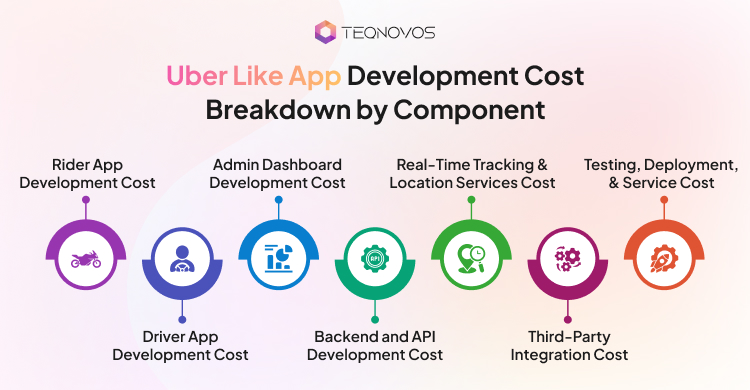
Uber-like App Development Cost Breakdown by Component
The development investment is distributed across multiple product components. Each component requires different engineering work based on the workflows it needs to support. The final budget depends on the applications required, backend systems, integrations, and operational tools included in the platform.
Rider App Development Cost
The rider application manages the customer side of the booking journey. It supports account management, ride discovery, booking, trip tracking, and payment-related activities.
Major development areas include:
- User account management
- Registration and login
- Profile management
- Saved preferences
- Ride booking workflow
- Pickup and destination selection
- Vehicle category selection
- Fare estimation
- Booking confirmation
- Trip management
- Live ride status
- Driver details
- Trip history
- Payment records
These components define the core application scope and determine which modules are included in the final product.
Driver App Development Cost
The driver application manages driver availability, ride requests, navigation workflows, trip execution, and earnings information.
Key development areas include:
- Driver onboarding
- Registration process
- Document submission
- Account verification
- Ride management
- Incoming ride requests
- Accept or reject actions
- Trip status updates
- Earnings management
- Revenue tracking
- Payment summaries
- Completed ride reports
The driver application focuses on availability management, ride acceptance, navigation workflows, and earnings tracking.
Admin Dashboard Development Cost
The admin dashboard controls daily platform operations. It requires tools that allow businesses to monitor users, drivers, transactions, and service performance.
Important components include:
- User and driver management
- Account controls
- Approval workflows
- Activity monitoring
- Ride operations
- Booking supervision
- Trip status tracking
- Issue management
- Business controls
- Pricing configuration
- Reports
- Analytics dashboards
The admin dashboard provides operational controls for managing users, drivers, rides, pricing, and platform activity.
Backend and API Development Cost
The backend connects all platform components and manages the core ride operations.
Major backend systems include:
- Authentication services
- User identity management
- Access control
- Ride management logic
- Booking processing
- Driver assignment
- Trip lifecycle management
- Pricing and payment systems
- Fare calculation
- Transaction processing
- Payment status updates
- Data management
- User records
- Trip history
- Operational data
Real-Time Tracking and Location Services Cost
Location technology is a major part of a ride hailing platform because the system continuously processes movement data.
Development areas include:
- GPS location updates
- Driver availability tracking
- Route calculation
- Estimated arrival time generation
- Live trip status synchronization
Real-time systems require continuous processing of location events, route updates, and trip status changes. The implementation approach varies based on the required tracking accuracy and platform usage.
Third-Party Integration Cost
External services extend the capabilities of the platform and connect it with essential systems.
Common integrations include:
| Integration | Purpose |
| Map APIs | Navigation, route planning, distance calculation |
| Payment gateways | Digital transactions and payment processing |
| SMS services | OTP verification and alerts |
| Push notifications | Real time user communication |
| Identity verification APIs | User and driver verification |
These integrations connect external services with booking, payment, communication, and verification workflows.
Testing, Deployment, and Maintenance Cost
Before launch, the platform goes through validation and deployment activities to ensure the applications and connected services are ready for production use.
Important areas include:
- Functional testing for booking workflows
- Device compatibility testing
- Performance testing
- Security validation
- Cloud deployment
- Monitoring setup
Features That Require Additional Engineering Effort in an Uber Like App
Not every feature requires the same level of implementation effort. Standard booking workflows can use established application logic, while advanced capabilities require additional backend processing, automation rules, data handling, and operational controls.
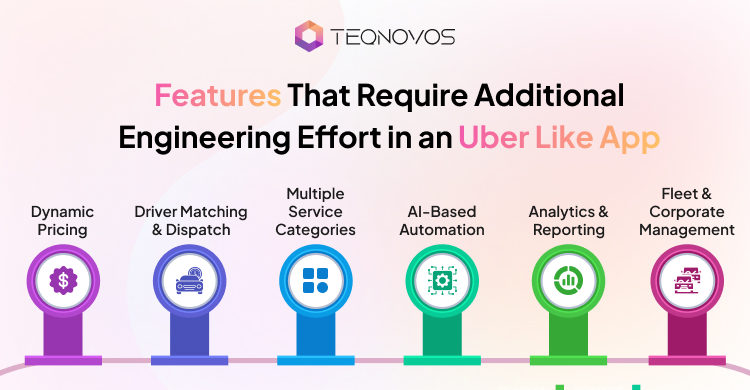
| Feature | Technical Complexity | Main Engineering Requirements |
| Dynamic Pricing | High | Pricing engine, fare calculation rules, demand-based adjustments, location-based pricing logic |
| Driver Matching and Dispatch | Very High | Geospatial search, driver availability tracking, matching algorithms, trip allocation logic |
| Multiple Service Categories | High | Separate workflows, service-specific rules, pricing structures, vehicle category management |
| AI-Based Automation | Very High | Data pipelines, model integration, prediction workflows, monitoring systems |
| Analytics and Reporting | Medium to High | Data collection, reporting models, dashboards, business metrics processing |
| Fleet and Corporate Management | Medium to High | Account hierarchy, role permissions, billing workflows, fleet-level reporting |
Dynamic Pricing Engine
Dynamic pricing requires a configurable pricing system rather than a fixed fare calculation method. The platform needs rules that adjust fares based on business conditions such as distance, duration, demand patterns, and service zones.
Key technical components include:
- Fare calculation engine
- Pricing rule configuration
- Surge pricing logic
- Location-based pricing zones
- Fare validation workflows
Driver Matching and Dispatch System
A ride hailing platform needs more than a simple driver request system. The dispatch layer evaluates driver availability, location proximity, trip status, and assignment rules before allocating rides.
Key technical components include:
- Real-time driver availability
- Geospatial search
- Matching algorithms
- Assignment rules
- Trip state management
Multiple Service Categories
Supporting different services requires separate operational workflows within the same platform. Each category may require different booking rules, pricing structures, and management controls.
Examples include:
- Passenger rides
- Vehicle rentals
- Delivery services
- Corporate transportation
Additional technical requirements include:
- Service-specific workflows
- Vehicle category configuration
- Pricing models
- Access permissions
AI-Based Automation
AI capabilities require supporting data systems rather than only adding an AI model. Businesses exploring predictive features can also consider AI software development services for implementing automation, recommendations, and data-driven workflows.
Common applications include:
- Demand forecasting
- Driver allocation recommendations
- Fraud detection
- User behaviour analysis
Technical requirements include:
- Historical trip data preparation
- Data processing pipelines
- Model integration
- Performance monitoring
Analytics and Reporting
Advanced reporting requires structured data collection and processing systems. Businesses can create operational dashboards to monitor platform activity and performance.
Common reporting areas include:
- Trip performance
- Revenue analysis
- Driver activity
- User behaviour
- Operational metrics
Fleet and Corporate Management
Enterprise mobility platforms require additional controls for fleet operators and corporate customers.
Key requirements include:
- Multi-account management
- Role-based permissions
- Fleet reporting
- Invoice generation
- Corporate billing workflows
Estimate the Investment Required to Build Your Uber-Like App. Get Your App Development Cost Estimate!
Schedule a CallOverall Uber-Like App Development Cost Comparison
The investment varies based on the development approach selected. Businesses can choose a predefined launch package for common mobility requirements or opt for custom development when they need unique workflows and platform logic. Those comparing the cost to build Uber clone solutions can consider a white label approach that uses an existing foundation with customization options based on branding, integrations, and business requirements.
| Development Option | Estimated Investment | Suitable For | Scope |
| MVP Launch Package | ₹1.5 lakh to ₹4 lakh ($1,800 to $4,800) | Businesses testing one core ride service | Rider app, driver app, admin panel, basic booking, dispatch, maps, payments, notifications, and initial deployment |
| Full Multi-Service Package | ₹8 lakh to ₹20+ lakh ($9,500 to $24,000+) | Businesses planning broader mobility expansion | Multiple service modules, custom workflows, advanced pricing, delivery, rentals, corporate features, integrations, testing, deployment, and licensing |
| Custom Development | $12,000 to $25,000+ | Businesses requiring unique workflows | Custom architecture, business-specific logic, tailored applications, backend systems, APIs, and integrations |
| White Label Uber Clone | $3,000 to $10,000 | Businesses seeking faster deployment | Existing platform foundation with branding, customization, selected integrations, and deployment support |
What Is Included in the Estimated Development Cost?
The estimated investment generally covers the core product development activities required to prepare the platform for launch. Third party usage charges and ongoing operational expenses are usually handled separately.
| Cost Area | Included in Development Estimate | Usually Charged Separately |
| UI/UX Design | User flows, interface design, and screen preparation | Additional redesign cycles beyond approved scope |
| Application Development | Rider app, driver app, admin panel, and required platform modules | New modules added after project scope approval |
| Backend Development | APIs, database setup, business logic implementation, and system integration | Major architecture changes after development starts |
| Quality Assurance (QA) | Functional testing, device testing, and issue resolution before launch | Continuous testing after major post-launch changes |
| DevOps and Deployment | Production setup, application deployment, and basic environment configuration | Ongoing cloud management and infrastructure expenses |
| Third Party Services | API integration setup for required services | Usage fees for maps, payment gateways, SMS, and verification providers |
| App Store Deployment | Assistance with app submission and release preparation | Developer account fees charged by app marketplaces |
| Post Launch Support | Initial issue resolution based on agreed support terms | Long term maintenance contracts and feature enhancements |
The exact inclusions vary based on the selected development package and project scope. Businesses should confirm deliverables, ownership terms, support coverage, and third party service responsibilities before starting development.
Component-wise Development Cost Breakdown for an Uber Like App
Businesses comparing the cost to build Uber clone solutions can use component-level estimates to understand which modules require customization and where the development investment is allocated.
| Component | Estimated Cost | Main Development Scope |
| Rider App | $4,000 to $6,000 | User registration, booking workflow, fare estimation, trip tracking, payment integration, ride history |
| Driver App | $2,000 to $5,000 | Driver onboarding, availability management, ride requests, navigation workflow, earnings tracking |
| Admin Dashboard | $2,000 to $5,000 | User management, driver management, ride monitoring, pricing controls, reports |
| Backend and Real Time Infrastructure | $4,000 to $8,000 | API development, database architecture, authentication, dispatch logic, location processing, real-time communication |
| Total Custom Development | $12,000 to $25,000 | Complete custom ride hailing platform |
Example Budget Breakdown for a Single City MVP
A single-city MVP with rider app, driver app, admin dashboard, basic dispatch, maps, payment integration, and essential booking workflows usually requires a focused development scope. The budget allocation can look like this:
| Development Area | Approximate Budget Allocation |
| UI/UX Design | $1,000 to $2,000 |
| Rider App Development | $4,000 to $6,000 |
| Driver App Development | $2,000 to $5,000 |
| Admin Dashboard | $2,000 to $5,000 |
| Backend and API Development | $4,000 to $8,000 |
| Quality Assurance and Deployment | $1,000 to $3,000 |
| Estimated Total | $12,000 to $25,000 |
Choosing Between Custom Development and an Uber Clone Solution
Businesses building a ride hailing platform usually compare custom development with an existing Uber clone solution. Understanding Uber clone cost helps businesses evaluate whether a ready-made platform matches their requirements.
| Decision Factor | Custom Development | Uber Clone Solution |
| Platform foundation | A new architecture is created based on the business model, service structure, and operational requirements | Uses existing ride booking modules that can be modified based on branding and business needs |
| Workflow customization | Supports unique booking logic, pricing rules, service categories, driver allocation methods, and operational processes | Works well for businesses following standard ride booking workflows with selected modifications |
| Code ownership and control | Provides greater control over application logic, integrations, and future product changes | Depends on the solution model and available customization options |
| Development approach | Requires product planning, UI design, application development, backend implementation, and testing | Focuses on configuration, customization, integration, and deployment of an existing framework |
| Future expansion | Allows businesses to add custom modules based on changing requirements | Expansion depends on the flexibility of the existing platform structure |
A custom-built platform is suitable for businesses that need unique operational workflows, specialized pricing models, or complete control over future enhancements. An Uber clone solution fits businesses that want to launch with established ride booking functionality and customize the platform around their brand and service requirements.
The decision should consider factors such as required business logic, ownership expectations, customization needs, and the planned growth path of the platform.
Technology Stack and Infrastructure Cost Factors
An Uber like app requires multiple technical layers to manage ride requests, driver availability, live location updates, payment processing, and operational data. The technology approach affects the development effort, system architecture, and infrastructure requirements needed to support these workflows.
| Technology Area | Common Options | Cost Impact |
| Mobile Application Development | Flutter, React Native, Swift, Kotlin | Cross platform development can reduce initial development effort by sharing code across platforms. Separate native applications for iOS and Android require additional implementation but allow deeper platform specific customization and device optimization. |
| Backend Development | Node.js, NestJS, Laravel, Django | Backend architecture determines how ride requests, pricing rules, payment workflows, and operational logic are structured. A simple application may use a centralized backend, while platforms with multiple services may require modular services, separate APIs, and additional system coordination. |
| Database Layer | PostgreSQL, MySQL, MongoDB | The database manages user profiles, driver records, trip history, transaction data, location information, and reporting records. Data volume, query requirements, and reporting needs influence database design and optimization efforts. |
| Real Time Communication | WebSockets, event driven services, messaging systems | Real time architecture handles continuous events such as driver availability changes, ride status transitions, and location updates. The communication method affects event processing, response speed, and infrastructure required to manage frequent updates. |
| Cloud Infrastructure | AWS, Azure, Google Cloud | Cloud architecture needs to support application traffic, location events, stored trip data, and operational reporting requirements after launch. |
Infrastructure Areas That Influence Long-Term Expenses
After launch, operational costs come from the systems required to run and maintain the platform.
| Infrastructure Area | Cost Considerations |
| Cloud Resources | Server capacity, database performance, storage usage, and bandwidth consumption based on platform activity |
| Map and Location Services | Route calculations, geocoding requests, navigation features, and location tracking volume |
| Data Storage | Trip records, payment history, user activity logs, and analytics data |
| Monitoring and Performance Tools | Application monitoring, error tracking, and performance analysis |
The technology approach should match the platform requirements. A business launching an MVP may use a simpler architecture, while a multi-service mobility platform may require additional infrastructure planning for higher transaction volumes and operational activity.
Plan Your Uber-Like App Development With a Clear Cost Roadmap. Build Your Uber-Like App Today!
Schedule a CallDevelopment Timeline and Cost Relationship
The delivery timeline changes based on project scope, customization requirements, approval cycles, and implementation dependencies. These factors also influence on demand app development cost because longer development cycles require additional planning, implementation, and validation efforts. An MVP can be launched faster because it focuses on essential ride workflows before expanding into advanced platform capabilities.
| Development Approach | Estimated Timeline | Typical Scope |
| MVP Launch | 3 to 4 months | Core rider app, driver app, admin panel, booking workflow, basic dispatch, maps, payments, notifications, and initial deployment |
| Full Multi-Service Platform | 6 to 12+ months | Multiple service modules, custom workflows, advanced pricing, integrations, testing, deployment, and additional operational capabilities |
| Custom Uber Like Platform | 6 to 12+ months | Custom rider app, driver app, admin dashboard, backend services, real time infrastructure, and tailored business logic |
| White Label Uber Clone | 1 to 3 months | Existing platform customization, branding, selected feature modifications, integrations, and deployment |
Factors That Extend the Development Timeline
| Timeline Factor | Why It Adds Time |
| Custom business logic | Unique pricing rules, dispatch methods, or operational workflows require additional development cycles |
| Third party integrations | Payment gateways, maps, verification services, and external APIs require configuration and validation |
| Revision cycles | Changes after design or development approval can require additional implementation and testing |
| Platform expansion | Adding new services or workflows during development affects planning and delivery stages |
| Launch preparation | App store approvals, production setup, and final release checks influence launch timing |
A shorter timeline does not always mean adding more developers. Some activities depend on completed decisions, approvals, and technical dependencies. Defining the launch scope early helps avoid additional development cycles and timeline extensions.
Costs to Consider After Launching an Uber Like App
The initial development budget covers building and deploying the platform. After launch, businesses need to account for recurring expenses related to infrastructure usage, external service consumption, platform updates, and operational support.
| Cost Area | What Creates the Expense | Typical Ongoing Requirement |
| Cloud Hosting and Data Storage | Server usage, database operations, stored trip records, user activity data, and backup requirements | Costs increase as booking volume, active users, and stored data grow |
| Map and Location API Usage | Route requests, distance calculations, geocoding, navigation requests, and location tracking volume | Higher trip activity results in more API consumption |
| Payment Processing Fees | Transaction charges, refunds, failed payment handling, and settlement processes | Expenses vary based on payment volume and transaction providers |
| SMS and Communication Charges | OTP verification, ride alerts, driver notifications, and customer messages | Usage grows with registrations, bookings, and communication frequency |
| App Store and Platform Accounts | Developer accounts, publishing requirements, and platform compliance updates | Required for maintaining app availability on mobile marketplaces |
| Security and Compliance Updates | Vulnerability fixes, dependency updates, access reviews, and security monitoring | Needed when platforms, libraries, or security requirements change |
| Compatibility and Release Updates | Operating system changes, device support updates, and app version releases | Required to maintain support for newer Android and iOS versions |
| Customer Support Operations | User queries, driver assistance, dispute handling, and operational support tools | Support requirements increase with platform usage |
Final Thoughts
The cost to build an Uber-like app depends on the platform scope, customization needs, and long term product goals. Businesses can control investment by defining essential launch requirements and adding advanced capabilities as the platform grows. A clear roadmap helps allocate the budget effectively across development, operations, and future improvements. Moreover, working with experienced on-demand app developers can help align platform scope, technical requirements, and long-term expansion plans.