


















Car Rental Modernization: How Businesses Upgrade Legacy Rental Platforms
Many rental businesses reach a stage where their existing systems cannot support new operational demands. Manual booking updates, disconnected fleet records, and limited reporting create delays across daily workflows. Car rental modernization helps businesses address these limitations by upgrading outdated platforms while preserving important operational data.
A structured modernization approach enables rental companies to enhance system flexibility and integrate essential tools. This helps them prepare their platforms for future requirements. It focuses on improving existing technology foundations instead of adding new features. This helps businesses manage changing customer expectations and evolving rental operations.
What Is Car Rental Modernization and Why Does It Matter?
It focuses on upgrading existing rental technology to meet changing business requirements. The process involves improving outdated software and connecting disconnected systems. Thus, creating a flexible foundation for rental operations. Unlike building a completely new platform, modernization improves existing technology assets while preserving valuable business processes and data.
Moving Beyond Legacy Rental Software
Many rental businesses rely on systems that were built for earlier operational needs. Over time, these platforms can develop limitations such as isolated databases and manual workflows. Car rental software modernization addresses these challenges by improving application structure and system connectivity.
Building a More Adaptable Rental Platform
Car rental platform modernization creates a stronger foundation for future improvements. Businesses can update booking workflows, fleet operations, reporting capabilities, and customer-facing services without depending on outdated technology. This approach follows application modernization services principles by improving the architecture, flexibility, and integration capabilities of existing systems.
The objective is not just to replace the old software. It is to create a rental platform that can adapt to new integrations and operational demands over time.
Why Traditional Rental Software Cannot Support Modern Businesses
Many rental businesses continue using software that was designed for simpler operational needs. As rental operations become more complex, older systems often struggle with real-time availability updates, branch-level inventory management, pricing rules, and connected customer services. Legacy car rental software modernization becomes necessary when existing platforms create operational gaps instead of supporting daily rental workflows.
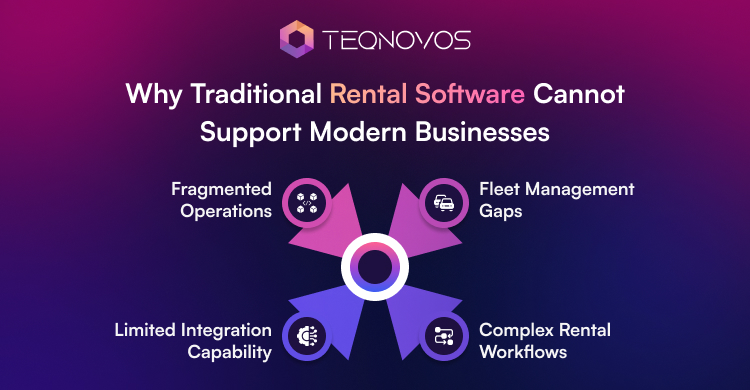
1. Fragmented Operations
Rental businesses manage multiple activities across reservations, fleet allocation, vehicle returns, inspections, and customer communication. Older systems often keep this information separated, making it difficult for teams to maintain accurate operational visibility.
Common challenges include:
- Vehicle availability not updating after cancellations or rental extensions
- Branch teams managing separate inventory records
- Delays in assigning available vehicles
- Manual coordination between rental departments
A connected car rental management software platform helps businesses create smoother workflows across different operational areas.
2. Fleet Management Gaps
Fleet operations involve more than storing vehicle details. Businesses need accurate information about vehicle status, location, maintenance schedules, and availability before assigning vehicles to customers.
Older platforms may struggle with:
- Tracking vehicles between branches
- Updating maintenance status
- Managing inspection records
- Monitoring vehicle utilization
Fleet management software modernization helps rental companies improve control over vehicle operations and make availability decisions using accurate information.
3. Complex Rental Workflows
Car rental businesses often manage rules that are unique to their operations. These include one way rentals, airport surcharges, deposits, insurance options, mileage limits, and late return charges.
Older systems may require manual handling for:
- Pricing adjustments
- Rental extensions
- Refund calculations
- Additional service requests
Modernizing these workflows allows businesses to manage complex rental scenarios with better accuracy and less manual effort.
4. Limited Integration Capability
Modern rental operations depend on multiple connected services such as payment gateways, booking channels, mapping tools, accounting platforms, and telematics systems.
Older platforms may create challenges such as:
- Limited API connectivity
- Duplicate data entry
- Delayed information exchange
- Difficult third-party integrations
A modern architecture allows rental systems to exchange information more effectively across essential business tools. Businesses implementing car rental modernization services can address these technology gaps by improving the platform for daily rental operations.
Modernization vs Replacement: Choosing the Right Path
When rental software starts limiting business growth, companies usually evaluate two options: improving the existing platform or replacing it completely. The right choice depends on system condition and business objectives. It also depends on available resources and future requirements.
| Decision Factor | Car Rental Platform Modernization | Complete Platform Replacement |
| Best suited for | Businesses with functional systems that need upgrades | Businesses with outdated systems that block growth |
| Main goal | Improve existing technology and workflows | Build a new technology foundation |
| Existing data | Existing customer, fleet, and booking data can often be preserved | Data usually requires migration into a new platform |
| Implementation approach | Upgrade selected modules and improve architecture gradually | Develop and deploy a new platform environment |
| Business disruption | Usually lower because changes can happen in phases | Higher due to larger system transition |
| Suitable scenarios | Adding integrations, improving workflows, upgrading outdated components | Replacing unsupported systems or redesigning operations |
Modernization Strategy
Rental software modernization allows businesses to improve existing platforms without losing valuable operational knowledge. Companies can upgrade specific areas such as reservation workflows and fleet operations. They can also upgrade reporting systems and third-party integrations while keeping essential processes intact.
Replacement Strategy
A complete replacement may be required when the current platform cannot support required changes. This approach involves creating a new system architecture, migrating business data, and redesigning workflows around modern requirements.
Selecting the Right Approach
The decision begins with a technical and business assessment. Companies need to review system limitations and integration requirements. It also needs to review the data complexity and future expansion plans before selecting a modernization path.
Assessing an Existing Rental Platform Before Modernization Begins
Before starting car rental software development, businesses need a clear understanding of their existing platform. A technical assessment identifies outdated components and operational limitations. It finds the areas that require improvement. This step prevents businesses from making unnecessary changes and creates a practical roadmap for modernization.
1. System Structure
The first review focuses on how the rental platform is built. Businesses evaluate application layers, dependencies, databases, and custom modules to understand how different components interact.
This assessment identifies:
- Monolithic structures that limit updates
- Outdated technologies
- Hard-coded business rules
- Modules that can be improved independently
A clear view of the system structure helps determine the right modernization approach.
2. Data Flow
Rental platforms manage continuous data movement between bookings, vehicles, customers, payments, and external services. Businesses need to understand how information moves across the platform before making architectural changes.
The review focuses on:
- Data storage methods
- Data accuracy
- Duplicate information
- Transfer requirements between systems
This creates a reliable foundation for legacy car rental software modernization projects.
3. Business Workflows
Software should reflect how rental teams operate. An assessment reviews daily processes such as vehicle allocation, reservation management, customer communication, and internal approvals.
This helps identify:
- Manual tasks slowing operations
- Unnecessary process steps
- Workflow gaps between departments
- Areas suitable for automation
The goal is to modernize the system around actual business operations.
4. Technology Dependencies
Existing rental platforms often depend on third-party tools and older technologies. Businesses need to identify these dependencies before making changes.
The review covers:
- External software connections
- API availability
- Vendor dependencies
- Technology limitations
This information helps businesses plan upgrades without disrupting connected services.
5. Security Controls
Security evaluation helps identify weaknesses within existing rental platforms. Businesses review how the system manages access, protects information, and handles sensitive transactions.
Key areas include:
- User permissions
- Data protection methods
- Authentication processes
- Compliance requirements
This ensures security improvements become part of the modernization plan rather than a later adjustment.
Modernization Strategies for Car Rental Software Platforms
Every rental platform has different technical limitations and business requirements. The approach depends on the condition of the existing system and the level of change required. A structured legacy system modernization strategy helps companies improve outdated platforms. It also helps maintain important workflows and operational continuity.
1. Rehosting
Rehosting involves moving an existing rental application to a modern infrastructure environment without making major changes to the application code. It is used when businesses need improved hosting capabilities but want to maintain the existing application behavior.
- Moving applications to cloud infrastructure
- Reducing dependency on outdated hosting environments
- Improving infrastructure management
- Creating a foundation for future modernization
However, rehosting does not remove deeper software limitations because the internal application structure remains unchanged.
2. Refactoring
Refactoring focuses on improving the internal quality of existing software without changing its core functionality. It helps businesses clean complex code structures and make applications easier to maintain.
- Improving application performance
- Reducing unnecessary code complexity
- Making future updates easier
- Improving maintainability of existing systems
Businesses can review similar modernization approaches through the platform refactoring case study, which demonstrates how outdated systems can be improved through structured technical changes.
3. Replatforming
Replatforming upgrades selected parts of an existing rental system by moving them to modern technologies or improved environments. It creates improvements without requiring a complete rebuild.
- Upgrading databases and infrastructure
- Improving system performance
- Adding modern integration capabilities
- Preparing platforms for additional services
Replatforming is useful for businesses that need stronger technology foundations while preserving existing operational processes.
4. Rebuilding
Rebuilding involves developing a new platform when existing software limitations prevent meaningful improvements. It requires redesigning application architecture and user experiences based on current business requirements.
- Replacing outdated application structures
- Designing flexible software architecture
- Introducing modern workflows
- Creating a stronger base for future expansion
A rebuild requires careful planning because businesses need to manage data migration, testing, and transition activities.
5. Module Based Modernization
Module-based modernization focuses on upgrading specific parts of a rental platform instead of changing the complete system at once. It allows businesses to improve high impact areas while continuing regular operations.
- Upgrading reservation management systems
- Improving fleet management capabilities
- Enhancing customer-facing applications
- Modernizing payment and reporting modules
Businesses can explore a car rental modernization case study to understand how structured modernization approaches can improve legacy workflows and operational processes. This approach is a practical form of car rental platform modernization because it aligns technology changes with business priorities.
Building the Technical Foundation of a Modern Rental Platform
A modern rental platform needs a technology structure that reflects how rental businesses operate. The system must manage reservations and vehicle availability. They also need to manage customer information and external services without creating disconnected workflows. Car rental technology solutions focus on improving the technical foundation behind these operations so businesses can manage complex rental processes more effectively.
A well planned architecture is an important part of rental platform modernization services. This determines how easily businesses can connect systems, manage data, and introduce new capabilities. Businesses can also improve connected workflows through mobile app development services that support customer booking applications and operational tools.
1. Connected Booking Ecosystem
Rental businesses receive bookings through multiple channels such as websites, mobile applications, partner platforms, and corporate accounts. A modern platform needs to keep availability, pricing, and booking information synchronized across these sources.
Key components include:
- Real-time reservation updates across channels
- API connections with booking partners
- Payment gateway integrations
- Automated data exchange between systems
This reduces conflicts such as double bookings, outdated availability, and manual reservation updates.
2. Fleet Intelligence Layer
Vehicle operations depend on accurate information about location, condition, availability, and usage. A modern fleet layer connects vehicle-related data with rental workflows.
Important components include:
- Vehicle location and telematics data
- Mileage and fuel records
- Maintenance schedules
- Inspection and damage records
This allows rental teams to make better decisions about vehicle allocation, servicing, and availability.
3. Modular Application Structure
Rental businesses often need to update specific parts of their platform without affecting the entire system. A modular architecture allows individual components to be improved based on operational priorities.
Common modules include:
- Reservation management
- Fleet operations
- Customer accounts
- Reporting dashboards
This approach allows businesses to improve selected workflows while keeping critical rental operations active.
4. Data Management Layer
Rental platforms generate information across bookings, customers, vehicles, payments, and branch activities. A structured data layer ensures this information remains accurate and accessible across different systems.
Important areas include:
- Centralized customer and vehicle data
- Rental history management
- Operational reporting
- Data preparation for analytics
Reliable data management also creates the foundation required for advanced capabilities such as AI-driven insights.
5. Infrastructure and Security
The underlying infrastructure affects platform reliability, performance, and protection of business information. Modern rental systems require infrastructure that can support daily operations while maintaining security standards.
Key considerations include:
- Cloud deployment options
- System monitoring
- User access controls
- Data protection practices
A strong technical foundation allows rental businesses to improve existing platforms without creating additional technology limitations.
Business Capabilities That Improve Through Rental Platform Modernization
Modernization projects usually begin with specific operational gaps. A rental company may not need every new capability at once. The focus is on improving the areas where outdated systems create delays or limited visibility.
The following capabilities are commonly upgraded during rental technology transformation projects based on business requirements.
1. Faster Rental Operations
Older platforms require employees to manually coordinate reservations, vehicle availability, and customer requests. Modern systems improve operational workflows by connecting these activities within a single environment.
- Reservation status updates across teams
- Vehicle availability management
- Internal approval workflows
- Rental lifecycle tracking
2. Smarter Fleet Control
Fleet data is one of the most important areas for rental businesses. Modernizing fleet related systems helps companies move beyond basic vehicle records and gain better operational control.
- Real-time vehicle status visibility
- Maintenance scheduling workflows
- Utilization tracking
- Location-based fleet insights
These improvements support better decisions around vehicle availability and operational planning.
3. Connected Customer Journeys
Many older rental platforms focus mainly on internal operations. Modern platforms extend capabilities across customer touchpoints to create smoother rental experiences.
- Digital booking experiences
- Customer account management
- Rental document workflows
- Self-service options
This reduces dependency on manual support for routine customer requests.
4. Integrated Business Systems
Rental companies often use separate tools for payments, accounting, customer management, and fleet operations. Disconnected systems create data gaps and repeated manual work.
- API-based integrations
- Unified data exchange
- Connected third-party services
- Automated information flow
5. Operational Intelligence
Legacy systems often store data without making it useful for decision-making. Modern platforms create better visibility by organizing operational information.
- Booking patterns
- Vehicle performance
- Revenue trends
- Customer behavior
This data foundation also supports future car rental technology solutions such as analytics and AI-based capabilities.
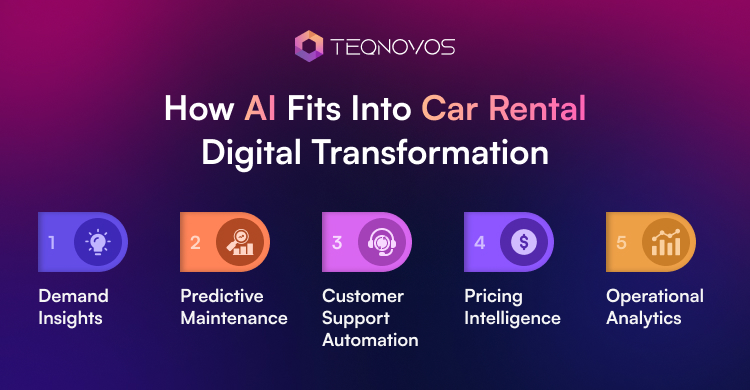
How AI Fits Into Car Rental Digital Transformation
Artificial Intelligence (AI) is becoming a valuable part of car rental digital transformation, but its effectiveness depends on the quality of the underlying platform. AI capabilities require structured data and reliable workflows to generate useful insights. Businesses need to modernize their software foundation before applying AI driven solutions.
A modern rental platform can create better opportunities for AI by organizing information across bookings and operations. The goal is not to replace human decision making but to improve planning and provide deeper operational visibility.
1. Demand Insights
Rental demand changes based on location and season. It also depends on customer behavior and external factors. AI can analyze historical rental patterns and operational data to identify demand trends.
Businesses can use these insights for:
- Understanding high-demand periods
- Improving vehicle availability planning
- Supporting inventory decisions
- Identifying changing customer preferences
This allows rental teams to make decisions using operational data instead of relying only on manual estimates.
2. Predictive Maintenance
Vehicle maintenance directly affects fleet availability and customer experience. AI based systems can analyze vehicle information and usage patterns to identify potential maintenance needs.
Predictive maintenance capabilities can include:
- Monitoring vehicle performance data
- Identifying unusual usage patterns
- Supporting proactive maintenance scheduling
- Reducing unexpected service interruptions
These capabilities work best when fleet data is accurate and consistently collected.
3. Customer Support Automation
AI can improve customer interactions by handling repetitive requests and providing faster responses. Businesses can integrate AI powered assistants into customer platforms to manage common rental queries.
Applications may include:
- Answering booking-related questions
- Providing rental information
- Supporting basic service requests
- Guiding customers through digital processes
Complex situations can still be handled through human support teams when required.
4. Pricing Intelligence
Rental pricing depends on multiple factors such as demand, vehicle category, location, and availability. AI can analyze these variables to provide pricing recommendations.
Pricing intelligence can support:
- Identifying demand-based pricing opportunities
- Analysing historical pricing patterns
- Improving rate planning
- Supporting revenue decisions
AI recommendations should complement business rules rather than replace strategic pricing decisions.
5. Operational Analytics
AI can help businesses extract more value from rental data. When combined with modern AI software development services, rental platforms can analyze operational information and identify useful patterns.
Businesses can use analytics for:
- Performance monitoring
- Fleet utilization analysis
- Process improvement opportunities
- Business trend identification
AI becomes more effective when it is built on a modern technology foundation. A structured approach to car rental digital transformation allows businesses to prepare their platforms for intelligent capabilities.
Data Migration Challenges During Rental Software Modernization
Data migration is one of the most complex stages of legacy car rental software modernization. Rental businesses have years of customer records and vehicle information. They also hold booking history and operational data stored across different systems. Moving this information requires more than transferring files. It requires planning how data will be cleaned and connected with the modern platform.
A successful migration process focuses on maintaining data accuracy while reducing disruption to ongoing rental operations.
1. Data Assessment
Before migration begins, businesses need to understand what information exists within their current systems. This step identifies valuable records and dependencies between different applications.
- Reviewing existing databases and storage systems
- Identifying important business records
- Detecting duplicate or incomplete information
- Mapping data relationships between systems
2. Data Transformation
Older rental platforms often store information in formats that may not match modern systems. Data transformation prepares existing records for the new platform structure.
- Converting outdated data formats
- Standardizing customer and vehicle information
- Cleaning inaccurate records
- Aligning data fields with the new system
3. System Transition
Moving from an existing rental platform to a modern system requires careful transition planning. Businesses need to decide how migration will happen while keeping daily operations running.
- Choosing phased or complete migration
- Testing migrated information
- Managing active bookings during transition
- Coordinating system cutover activities
4. Data Security
Rental platforms handle sensitive business and customer information. Migration activities need strong security controls to protect data during movement and storage.
- Controlled access during migration
- Secure data transfer methods
- Backup planning
- Validation after migration
5. Migration Validation
After migration, businesses need to verify that the new platform works correctly with transferred information.
- Checking record accuracy
- Testing connected workflows
- Confirming system performance
- Reviewing user access
Common Mistakes Businesses Make During Rental Software Modernization
A successful rental technology transformation project requires more than upgrading technology. Businesses face challenges when they focus only on software changes without evaluating existing requirements. Identifying common mistakes early helps companies avoid unnecessary costs and technology decisions that do not solve actual operational problems.
1. Skipping Assessment
Starting modernization without reviewing the existing platform can lead to incorrect decisions. Businesses need to understand current architecture and workflows. They need to know platform integrations and data structures before selecting a modernization approach.
Common issues include:
- Rebuilding systems that could have been improved
- Missing critical dependencies
- Underestimating migration complexity
- Selecting unsuitable technologies
A detailed assessment creates a clearer modernization roadmap.
2. Copying Competitors
Rental businesses look at competitor platforms and try to replicate their features. This approach can result in unnecessary development work. Every business has different workflows and customer requirements.
A better approach focuses on:
- Existing operational challenges
- Customer expectations
- Business expansion plans
- Required system improvements
Modernization should solve business problems rather than duplicate another platform.
3. Ignoring Data Quality
Poor quality data can create issues after migration. Older rental systems may contain duplicate records and inconsistent formats that affect the performance of the modern platform.
Businesses review:
- Customer information accuracy
- Vehicle records
- Booking history
- Data relationships
Clean and structured data creates a stronger foundation for the new system.
4. Over Customizing Workflows
Some businesses try to recreate every old process within a modern platform. This can increase complexity and prevent teams from benefiting from improved workflows.
Modernization should identify:
- Processes that need improvement
- Tasks suitable for automation
- Workflows that no longer add value
- Areas requiring standardization
The goal is to improve operations rather than transfer outdated limitations into a new system.
5. Ignoring Integration Planning
Rental platforms rarely operate alone. They depend on payment systems and mapping services. It also depends on accounting tools and other business applications.
Missing integration planning can create:
- Data gaps between systems
- Manual work after launch
- Limited platform functionality
- Additional development requirements
Integration requirements should be considered during the early planning stages.
6. Treating Modernization as a UI Upgrade
A new interface does not solve deeper technology problems. User experience improvements are important; modernization also involves architecture and operational workflows. Businesses need to focus on improving the complete platform foundation instead of only changing the visual design.
Cost Factors That Influence Software Modernization Approach
The investment required for rental platform improvements depends on the condition of the existing platform and the level of transformation required. Unlike new software development, modernization involves reviewing current systems and improving the overall technology foundation.
The cost is influenced by several factors:
| Modernization Area | Impact on Project Investment |
| Platform Assessment | Understanding existing architecture, dependencies, and technical limitations requires initial analysis before development begins. Complex systems usually require deeper evaluation. |
| Architecture Improvements | Updating outdated structures, introducing modular components, or improving APIs can increase effort depending on the condition of the existing platform. |
| Data Migration | Moving customer records, booking history, fleet information, and operational data requires cleaning, mapping, testing, and validation. |
| Module Upgrades | Modernizing booking systems, fleet management, customer portals, reporting tools, or payment workflows changes the overall scope. |
| Integration Requirements | Connecting external services such as payment gateways, mapping tools, CRM platforms, or partner systems affects development complexity. |
| Security Enhancements | Improving authentication, access controls, and data protection practices adds additional planning and testing requirements. |
| Testing and Deployment | Modernization requires extensive validation to ensure upgraded systems continue supporting existing operations. |
Additional Costs Businesses Should Consider
Modernization does not end after deployment. Businesses should also plan for ongoing technology requirements.
| Ongoing Requirement | Why It Matters |
| Cloud Infrastructure | Supports application hosting, monitoring, and performance management. |
| Software Maintenance | Covers updates, fixes, security improvements, and compatibility changes. |
| System Monitoring | Helps identify performance issues and operational problems. |
| Feature Enhancements | Allows the platform to adapt as business requirements change. |
Practical Roadmap for Modernizing a Car Rental Platform
For any project involving car rental modernization to be successful, there needs to be an approach where the business and technological changes work hand in hand. The business needs to have an idea of its current platform so that the changes can be implemented without affecting business operations.
1. Platform Assessment
The first stage focuses on understanding the current technology environment. Businesses review existing applications and operational limitations.
This assessment helps determine which areas require improvement and which existing components can continue to support operations.
2. Modernization Planning
After the assessment, businesses define the modernization strategy based on their goals and technical requirements. This stage determines the scope and implementation strategy.
A clear plan reduces unnecessary changes and keeps modernization aligned with business goals.
3. Architecture Design
The architecture stage focuses on creating the foundation for the modernized platform. Businesses define how applications, data, and integrations will work together.
A well designed architecture improves flexibility and supports future enhancements.
4. Module Development
Modernization happens through selected module upgrades rather than changing the complete platform. Businesses can focus on areas that create the highest operational impact.
This approach allows businesses to improve important areas and maintaining existing operations.
5. Data Migration
Data migration transfers valuable business information from existing systems into the modernized platform. This stage requires careful planning to maintain accuracy and usability.
A structured migration process reduces risks related to customer, vehicle, and booking information.
6. Testing and Deployment
Before launching the updated platform, businesses need to verify that all workflows, integrations, and user functions work correctly.
After successful testing, the modernized platform can be deployed with proper transition planning.
7. Continuous Improvement
Car rental digital transformation does not end after deployment. Businesses need ongoing improvements to adapt to changing requirements and technology advancements.
A phased roadmap allows rental businesses to modernize their platforms. It creates a foundation for long term tech growth.