


























Impact of Digital Transformation Solutions in Healthcare: Consulting, Challenges, and Strategy
Launching a patient portal or replacing a legacy platform does not transform care by itself. Staff may still rekey data. Clinicians may bypass new screens. Managers may count logins without testing changes in access or safety. These gaps appear when a technology project lacks an operational owner and a defined decision path.
A healthcare digital transformation strategy connects each investment to a specific clinical or business problem. It identifies the workflow that changes and assigns accountability for adoption while defining evidence before work begins. Successful digital transformation in healthcare therefore starts before development. Leaders need to agree on the outcome. They document the baseline and map affected roles. They also decide what evidence will justify broader rollout.
What Is a Healthcare Digital Transformation Strategy?
This strategy is a governing set of choices that links care and business outcomes with workflow change. It sets data rules and directs technology investment. It names the people who approve tradeoffs and own results. Its first job is to decide which problems deserve funding and what evidence will prove progress.
The strategy states a baseline for every priority. It describes the future workflow and identifies dependent systems. It defines access rights and data ownership. It sets adoption measures and clinical safety checks. This structure turns healthcare digital transformation into a controlled operating program rather than a collection of software projects.
Organizations can review digital transformation solutions for healthcare to understand common platforms and integration patterns. The strategy itself remains technology neutral until leaders confirm the operational need and delivery constraints.
Three documents guide different levels of digital transformation in healthcare:
| Document | Main purpose | Main output |
| Strategy | Establishes choices and success conditions | Approved transformation priorities |
| Roadmap | Sequences initiatives and dependencies | Delivery horizons |
| Implementation plan | Assigns tasks and resources | Execution schedule |
How Does Strategy Change Healthcare Decisions?
Strategy changes healthcare decisions by replacing broad ambitions with rules that managers can apply. Digital transformation in healthcare forces teams to identify the critical bottleneck. They also name the person who can change the workflow and the proof that unlocks funding. One accountable owner holds the final decision.
1. Access Choices
Leaders define the access failure before choosing a portal or scheduling tool. Referral leakage and unavailable appointments require different interventions. So does incomplete intake data. The selected measure exposes the exact failure.
2. Workflow Authority
A clinical tool often shifts tasks among clinicians and patients. The strategy records who accepts that transfer. It tests the proposed workflow for safety and workload. It also confirms that staff receive the required data at the right point.
3. Investment Control
Healthcare transformation requires a funding gate that weighs value against dependency cost. Leaders compare configuration and integration with replacement or retirement. This makes the digital transformation of healthcare a portfolio decision instead of a departmental request queue.
What Is Reshaping the Digital Transformation Market in Healthcare?
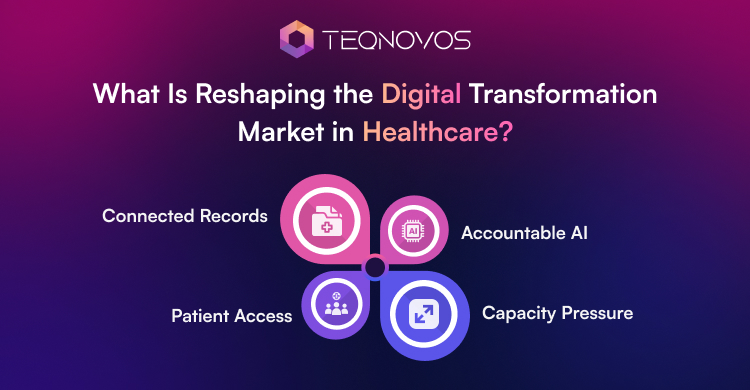
The digital transformation market in healthcare is moving beyond tools that solve one task. Buyers now assess workflow fit and operating cost. They also test future access to their data. These checks make digital transformation for healthcare a governance decision rather than a feature comparison.
1. Connected Records
Systems exchange useful patient information without making staff enter it again. Buyers also want clear rights to retrieve their data when a contract ends. This limits dependence on one vendor and keeps future choices open.
- Shared patient information
- Fewer duplicate entries
- Defined data export rights
- Practical vendor exit plans
2. Accountable AI
Artificial intelligence (AI) tools now face closer review before they enter clinical or administrative work. Leaders need to know who checks each output. They also need a response plan for unsafe or misleading results.
- Human review points
- Approved data uses
- Recorded AI decisions
- Error reporting process
3. Capacity Pressure
Staff shortages increase demand for automation. They also make poor design more damaging. A new tool removes work instead of adding screens. Cloud costs need review because charges can rise with use.
- Time saved per task
- Added staff steps
- Monthly cloud spending
- Cost per completed process
4. Patient Access
Patients expect simpler booking and faster responses. They also expect reliable access to their records. Providers cannot judge these tools by download numbers. They need measures that show if patients completed the intended task without staff assistance.
- Appointment completion rate
- Message response time
- Record access success
- Assisted support requests
Digital transformation in the healthcare industry now centers on control as much as innovation. This shift makes the digital transformation of healthcare an operational decision. Healthcare organizations often use healthcare app development services to create connected patient experiences across booking, communication, and care access workflows.
Build Your Healthcare Transformation Strategy. Start Your Digital Transformation Journey!
Schedule a CallWhat Does Healthcare Digital Transformation Consulting Deliver?
Healthcare digital transformation consulting turns an unclear modernization goal into decisions that leaders can approve, and teams can execute. The work starts with evidence. Consultants review how staff complete tasks and where information stops. They identify systems that create delays.
The findings become a healthcare digital transformation strategy with clear priorities and owners. It also records funding choices and success measures. The result is more than a presentation. It is a set of working documents that leaders can use during budgeting and vendor selection.
Each output ends with a decision. A system inventory that only lists software has little value. Organizations also need integration planning to understand how existing platforms exchange information through EHR and EMR integration services.
Teams planning data exchange can review this case study on healthcare interoperability solutions to understand the questions that arise when separate systems share patient information.
A digital transformation healthcare review also separates urgent issues from visible issues. A slow intake process may look like an application problem. The assessment may instead find that duplicate entry or unclear ownership causes the delay. That finding can move the budget from a full replacement to a focused connection or workflow correction.
Which Challenges Can Break the Strategy Before Scale?
A healthcare digital transformation strategy can fail before expansion when teams ignore operational risks during early stages. A pilot may show positive results while hidden dependencies remain unresolved. These issues become more visible when more departments adopt the system or when patient volume increases.
Leaders need to identify failure signals before wider rollout. Digital transformation in healthcare requires more than selecting a platform. It requires proof that data rules work. It requires safe transitions and clear ownership after implementation.
1. Hidden Logic
Legacy systems often contain rules that exist only through staff experience. These rules may control approvals or data movement. Replacing the system without identifying them can interrupt daily operations. Organizations often use application modernization services to improve legacy systems while protecting existing workflows and critical business data.
Consulting teams analyze dependencies between applications and workflows. The output creates a legacy rule register that documents critical behavior before modernization begins.
2. Poor Data Quality
Incomplete records can reduce the value of new platforms. Duplicate patient profiles can affect reporting. Missing fields can interrupt clinical workflows.
Data profiling identifies patterns that affect accuracy and usability. A remediation plan defines which records need correction and how teams will maintain quality after migration.
3. Unsafe Transition
A system change can create operational risk when teams do not prepare recovery steps. A failed migration or configuration issue can delay access to important information.
Continuity planning tests fallback procedures before launch. It creates a rollback and reconciliation plan that defines how teams restore operations and verify data accuracy.
4. Weak Adoption
Technology adoption fails when workflows do not match real staff behavior. Employees may continue using older tools if the new process creates additional steps.
Workflow observation helps identify practical barriers. An adoption recovery plan focuses on process changes and targeted support instead of forcing system usage.
5. Unclear Value
Many digital transformation in the healthcare industry projects struggle because teams cannot prove improvement. Activity numbers alone do not show better care delivery or operational efficiency.
Metric specification defines measurable outcomes before expansion. A benefits register tracks expected improvements and confirms whether investments create measurable impact.
6. Vendor and AI Risks
Vendor dependence can restrict future decisions when data export options are limited. An exit review identifies portability concerns early and creates a portability plan.
Uncontrolled AI creates another risk. Healthcare organizations need defined review rules before using AI in sensitive workflows. A risk assessment supports a model governance plan with monitoring requirements. Organizations handling PHI also need practices such as HIPAA-compliant software development to maintain secure system behavior during transformation.
What Determines Healthcare Transformation Consulting Scope and Cost?
Healthcare transformation consulting engagements differ because every organization starts with a different operating environment. A regional clinic may need workflow improvement across a few systems. A large health network may need data migration, interface redesign, regulatory review, and multi-site adoption planning. The scope depends on the number of processes affected and the level of support required.
The cost structure is influenced by project complexity rather than a fixed service package. A digital transformation healthcare initiative requires review of technology dependencies, clinical workflows, data requirements, and implementation risks before defining the engagement model.
1. Organization Complexity
The size of the organization directly affects consulting requirements. More facilities and teams create more workflows that need evaluation. Consultants review operational scale before defining activities and timelines.
- Number of hospitals, clinics, or departments involved
- Count of workflows requiring review or redesign
- Number of users affected by process changes
- Level of coordination between business and clinical teams
2. Technology Landscape
Existing system limitations can influence modernization decisions. Reviewing approaches such as electronic medical record modernization helps organizations understand how legacy platforms can be improved without disrupting care operations.
- Current system inventory and platform dependencies
- Number and complexity of interfaces
- Data migration volume and validation needs
- Legacy application limitations and replacement plans
3. Compliance and Change Needs
Healthcare organizations consider regulatory requirements and workforce readiness during transformation. Projects involving sensitive data require stronger controls and testing processes.
- Regulatory requirements affecting system design
- Security and privacy review requirements
- Training and adoption support needs
- Testing and cutover preparation activities
4. Engagement Model
Organizations can select different consulting approaches based on their internal capabilities and transformation goals. Each model provides a different level of involvement.
Assessment identifies current gaps and priorities. It helps leaders understand where improvement is required. Strategy and roadmap create transformation plans with timelines and investment priorities. Independent program assurance provides external oversight to review progress, risks, and delivery quality.
- Assessment defines current-state findings
- Roadmaps organize future transformation stages
- Advisory reduces technology selection risks
- Assurance validates execution progress and outcomes
How Can Leaders Measure Strategic Impact After Launch?
A healthcare digital transformation initiative needs defined measurement rules before leaders can confirm progress. Success cannot rely on system usage alone. Leaders need baseline data, trusted sources, and assigned owners to understand whether changes improve operations.
1. Define Measurement Rules
Leaders establish the starting point before launch. This creates a clear comparison between previous performance and future results.
- Document current workflow performance
- Define metric calculation methods
- Select trusted data sources
- Assign accountable metric owners
2. Track Operational Signals
Early indicators show whether teams are moving toward the expected outcome. These measures help leaders identify issues before they affect long-term results.
- Staff adoption of new workflows
- Manual task volume changes
- Failed interface transactions
- Time to access clinical information
3. Confirm Final Outcomes
Outcome indicators show whether transformation creates measurable improvement. Leaders review these measures over defined periods to validate progress.
- Appointment completion rate
- Referral turnaround time
- Duplicate record reduction
- Cost per completed workflow
4. Attribute Business Value
Benefits attribution connects results to specific transformation efforts. Leaders need evidence that improvements came from the implemented changes rather than unrelated factors.
- Compare results against baseline data
- Review changes with metric owners
- Track performance trends over time
- Document verified transformation impact
How to Select a Healthcare Digital Transformation Consultant
Choosing the right healthcare transformation consulting partner requires more than reviewing technology capabilities. Leaders need a consultant who understands clinical operations, system dependencies, and measurable business outcomes. The evaluation focuses on delivery experience and decision support rather than product promotion.
Evaluation Checklist
A strong consultant demonstrates practical experience across healthcare operations and technology planning.
- Understands clinical and administrative workflows
- Has Health Level Seven (HL7) and Fast Healthcare Interoperability Resources (FHIR) integration knowledge
- Builds data governance and security plans
- Assigns clear delivery leadership
- Provides vendor neutral recommendations
- Defines measurement methods before implementation
- Supports data ownership and exit planning
Essential Components of a Healthcare Digital Transformation Plan
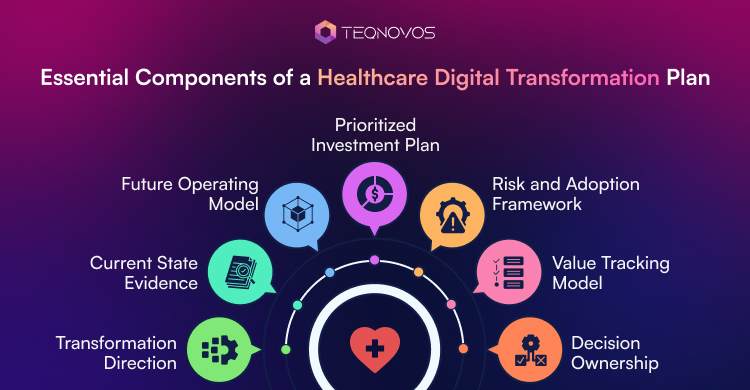
A board-ready healthcare digital transformation strategy gives senior leaders a clear view of the reason for change, expected outcomes, investment needs, and delivery controls. It connects transformation goals with measurable evidence and assigns ownership for every major decision.
1. Transformation Direction
The strategy starts with a clear transformation thesis. It explains the operational or clinical problem that requires change and defines the expected impact. Leaders need to understand why the initiative matters before reviewing technology options.
2. Current State Evidence
A strong strategy documents the current environment before proposing improvements. It includes baseline performance data, existing system capabilities, and workflow dependencies that influence future decisions.
3. Future Operating Model
The strategy defines how the organization will operate after transformation. It includes the target architecture, system relationships, and workflow changes required to support future goals.
4. Prioritized Investment Plan
Not every initiative can move forward at the same time. The strategy organizes initiatives based on value, risk, dependency, and available funding. Each stage needs clear approval points before additional investment.
5. Risk and Adoption Framework
Technology changes affect people and processes. The strategy explains how teams will adopt new workflows, manage risks, and maintain operational continuity during implementation.
6. Value Tracking Model
A board needs proof that transformation creates measurable impact. The strategy includes a benefits register, success measures, and criteria that define when initiatives scale or stop.
7. Decision Ownership
Clear ownership prevents delays during execution. The strategy identifies leaders responsible for approvals, risk decisions, funding reviews, and transformation outcomes.
A complete strategy helps boards evaluate digital transformation in healthcare through evidence, accountability, and measurable results. It creates a controlled path from approval to execution.
Evaluate Your Digital Transformation Roadmap. Talk to Our Healthcare Transformation Experts!
Schedule a CallConclusion
A healthcare digital transformation strategy helps leaders move from technology planning to controlled operational change. Successful digital transformation in healthcare depends on clear priorities and accountable decisions. Organizations need to evaluate workflows and adoption before scaling new capabilities.
The future of healthcare transformation requires a structured approach that connects clinical goals with technology decisions. The digital transformation of healthcare is not achieved through software adoption alone. It requires governance that supports long-term improvement.
Connect with Teqnovos to plan a structured approach for your healthcare transformation goals.